The Future of Asset Management Marketing: 8 Takeaways from Our Fireside Chat with CMO Lara Hoffmans, CFA

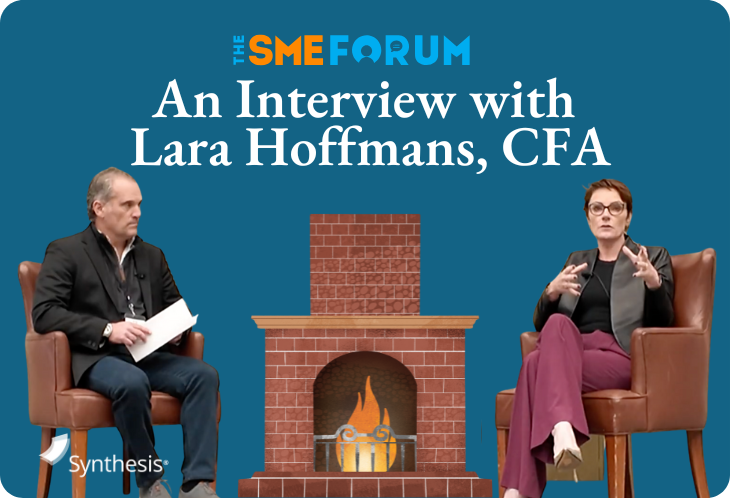
At this year’s SME Forum in Denver, Synthesis CEO Greg Healy sat down with Lara Hoffmans, a veteran Financial Services CMO and Synthesis client, for a fireside chat that unpacked the current state — and future — of asset-management marketing. What emerged was a highly practical, candid discussion about scaling in a world where content demands have exploded, but teams and budgets have not.
Here are the key takeaways and quotable moments from their conversation.
1. The Era of “Do More With Less” Is Reaching a Breaking Point
The conversation opened with a reality that nearly every CMO in investment management feels daily: the demand for marketing output has grown exponentially, but the resources to support that output have not.
As Lara put it:
“The amount of content we need to produce today is nothing like it was five or even three years ago. The pace, the volume, the customization — it’s all been turned up.”
She described the typical content cycle inside an asset manager:
- Content changes driven by markets or portfolio moves
- Data that updates monthly, sometimes weekly
- Compliance reviews that require new versions
- Sales teams needing different formats for different channels
- Advisors expecting real-time accuracy
But the fundamental process behind this cycle remains shockingly manual.
“You’re pulling data from multiple teams, copying content into different documents, chasing approvals…none of that scales.”
Greg reinforced that this isn’t a “marketing problem” — it’s a structural constraint that prevents teams from being strategic.
“Marketing teams aren’t struggling because they lack talent. They’re struggling because the system they’re working within doesn’t support the level of output the business expects.”
The takeaway: Modern CMOs need modern infrastructure.
2. Automation Isn’t Just About Speed — It’s About Reclaiming Strategic Capacity
Automation is often misunderstood as a way to “produce faster,” but Greg reframed it as an enabler of creative and strategic excellence:
“Automation isn’t about replacing people. It’s about eliminating the repetitive, error-prone work that gets in the way of people doing their best work.”
Lara reflected on how automation changed the culture of her team:
“Before automation, our time was consumed by updates — formatting, checking numbers, pushing versions through compliance. Once that burden went away, the quality of thinking in the team went up. We were able to focus on story, not structure.”
She described how even one automated process — monthly factsheets — had a cascading effect:
- Fewer emails
- Fewer versioning errors
- Fewer compliance delays
- Faster cycles
- More confidence internally and externally
Greg added an example from another client:
“They produce over 3,000 documents with a team of four people. That’s only possible because the system does the heavy lifting.”
It’s not the automation itself that drives impact — it’s how automation unlocks higher-value work.
3. Speed-to-Market Is Now a Core Competitive Advantage
The panel spent significant time on the impact of slow or inconsistent turnaround times. In an industry where product narratives shift quickly, being slow isn’t just inconvenient — it’s operationally risky.
Lara explained:
“If we can’t get updated content in the hands of Sales quickly, it erodes trust. They stop relying on marketing materials altogether.”
She gave examples familiar to every asset-management marketer:
- Sales teams emailing for “the most recent version”
- Outdated pitchbooks still floating around
- Advisors sharing materials from last quarter
- Product teams frustrated by slow content cycles
- Missed market windows during volatile months
Greg distilled it sharply:
“Speed isn’t a nice-to-have anymore. It’s table stakes.”
Automation supports this speed by ensuring that data, content, and templates update in sync, reducing the bottlenecks that typically slow firms down.
4. Clean, Governed Data Is the Foundation of Scale (Not an Afterthought)
Both leaders underscored that automation only works when the underlying data is governed, stable, and consistently owned.
Greg explained:
“Most firms think their issue is document production. Ninety percent of the time, the real issue is that the data feeding the documents is fragmented or unreliable.”
Lara echoed this with a vivid example:
“You have three different teams providing three different versions of AUM. Which one is correct? Which one is final? Who has authority? That alone can stall a project by days.”
Governance isn’t glamorous — but it is transformative:
- A single source of truth
- Clear data owners
- Standardized definitions
- Version-controlled updates
- Transparent change tracking
- Reduced back-and-forth on accuracy
Once this foundation is in place, automation becomes exponentially easier.
As Greg put it:
“You can’t automate chaos. Data governance is the difference between scaling gracefully or scaling disorder.”
5. Modern Marketing Requires Cross-Functional Alignment
One of the strongest themes from Lara was that effective marketing today requires organizational alignment, not just better tools.
“Marketing can’t operate as a sidecar. We need Product, Data, IT, Compliance — everyone needs to be part of the system.”
She described what happens when teams aren’t aligned:
- Competing versions of data
- Undefined approval gates
- Sales getting out-of-sync materials
- Product teams unaware of marketing timelines
- Compliance stuck reviewing work that isn’t ready
In contrast, when alignment works:
“When Product owns the data, Compliance owns the rules, and Marketing owns the experience — everything clicks.”
Greg added:
“The most successful firms treat marketing as a cross-functional engine, not a downstream asset factory.”
6. AI Will Accelerate Content Operations — But Only If the Data Is Right
While AI alone won’t fix foundational issues, both Greg and Lara highlighted its growing role in marketing efficiency.
Greg noted:
“AI should sit inside your existing workflows, not replace them. It accelerates the work — it doesn’t redefine it.”
Examples of AI’s impact included:
- Automated content validation
- Summaries for internal and sales use
- Draft commentary based on market moves
- Data reconciliation
- Version control guardrails
- Consistency and tone checks
Lara added an important caveat:
“AI is only as good as the data and structure underneath it. If your data is inconsistent, AI is going to scale that inconsistency.”
In other words: AI amplifies your operational maturity.
7. CMOs Must Quantify and Communicate Their Operational Impact
Both leaders were clear that modernization initiatives require executive sponsorship, and sponsorship requires clear metrics.
Lara shared the categories she reports up:
- Speed (time-to-market, update cycles)
- Accuracy (error reduction, data integrity)
- Efficiency (hours saved, fewer manual processes)
- Capacity (more output with same resources)
- Risk mitigation (compliance confidence, version control)
Executives respond to numbers, and CMOs who can demonstrate measurable operational improvement earn support for further investment.
Greg validated this:
“We routinely see clients double or triple their productivity. That’s a story leadership cares about.”
8. The Future of Asset-Management Marketing Is Systemized, Modular, and AI-Enhanced
As the discussion wrapped, Greg and Lara agreed that the next decade of asset-management marketing will be defined by firms that:
- Build governed, connected data foundations
- Construct modular content systems
- Automate repeatable workflows
- Use AI as an integrated accelerator
- Deliver content that is accurate in real time
- Provide Sales with instant access to updated materials
- Scale without adding headcount
- Align marketing, product, and compliance into a cohesive engine
Lara summarized it well:
“Modern marketing is predictable and repeatable. That’s what allows us to be creative, not the other way around.”
Greg concluded with a powerful perspective:
“The firms that invest in the right systems now — those are the firms that will scale, adapt, and win. Marketing is no longer a service function. It’s a strategic capability.”
Conclusion
This fireside chat underscored a critical truth: Asset-management marketing is undergoing a structural transformation.
The firms that lean into automation, governed data, integrated systems, and AI will operate with greater accuracy, confidence, and speed — and those who don’t will remain trapped in manual, reactive cycles that hold them back.
Synthesis is committed to helping asset managers build that modern foundation — flexibly, intelligently, and with the operational rigor that this industry demands.
Want more content like this? Sign up for our newsletter for more insights from the Synthesis Team.
Related Resource: A Case Study – How Diamond Hill Saved Time, Money, and Frustration with Synthesis


-
 The Future of Asset Management Marketing: 8 Takeaways from Our Fireside Chat with CMO Lara Hoffmans, CFA
 -
7 Problems With Automating Factsheets In PowerPoint
-
 The Growing Importance of ADA Compliance for Investment Companies
 -
Four, No FIVE things to Look for in a Content Automation Solution
-
10 Best Practices for Tailored Shareholder Report Design
Video: Who is Synthesis?
 Compare the Top 3 Finserv Content Automation Vendors [White paper]
 Create Pitchbooks the Drive Sales [White paper]
 Build vs. Buy: Should Your Financial Services Firm Outsource or Insource Marketing Technology? [White paper]
  10 Tips for Rebranding your Fund Marketing Documents [White paper]