Private Equity Group Saves $104K Annually Through Automated Fund Reporting
A leading private equity firm was managing a highly complex quarterly reporting process across a growing portfolio of investment products. Scaling quarterly fund reporting had become increasingly difficult for the team. As the number of funds grew, so did the complexity of managing data, maintaining consistency, and producing investor-ready reports within tight deadlines.
Synthesis helped the firm modernize its reporting operations through automated workflows, intelligent templates, and scalable data orchestration — transforming a labor-intensive process into a streamlined, repeatable operation built for growth.
Challenge
Producing investor communications required teams to manually gather, validate, and reconcile data from multiple internal systems and third-party providers — creating operational bottlenecks, version control issues, and significant production risk.
As demand for new fund launches increased, the organization faced mounting pressure to scale reporting without dramatically increasing headcount or sacrificing quality and compliance.
The key challenges were:
- Fragmented data sources across internal teams and third-party providers
- Manual reconciliation and validation processes that slowed production timelines
- Heavy dependency on institutional knowledge and specialized internal resources
- Inconsistent workflows between marketing, operations, compliance, and product teams
- Difficulty scaling production as new funds and reporting requirements were added
- Cultural resistance to process change due to legacy workflows and historical production methods
- High operational costs associated with maintaining manual reporting processes
The firm needed a more scalable operating model that could support growth while improving speed, consistency, and confidence across teams.
Solution
Synthesis partnered with the firm to design and implement a scalable content automation framework capable of transforming complex investment data into production-ready reports with significantly less internal effort.
Rather than requiring the client to standardize or rebuild their entire data infrastructure first, Synthesis integrated directly into existing workflows and data environments — including third-party data providers, internal systems, and legacy reporting processes.
The solution included:
- A centralized data foundation with custom loaders, historical data management, and automated validation logic
- A sophisticated business rules engine capable of handling fund-specific calculations, disclosures, layouts, and reporting variations
- Intelligent templates with dynamic charts, tables, and modular content blocks that preserved brand and design integrity
- Automated workflows that reduced dependency on manual production and specialized internal resources
- Embedded operational expertise from Synthesis teams, minimizing the need for the client to build and maintain large internal automation teams
- Cross-functional process alignment between marketing, operations, compliance, and product stakeholders
By combining technology with specialized implementation expertise, Synthesis helped the firm reduce operational complexity, lower the total cost of automation, and establish a scalable foundation for future growth.
Results
The firm transformed a highly manual reporting operation into a scalable, automated production process capable of supporting continued business growth.
The results were significant:
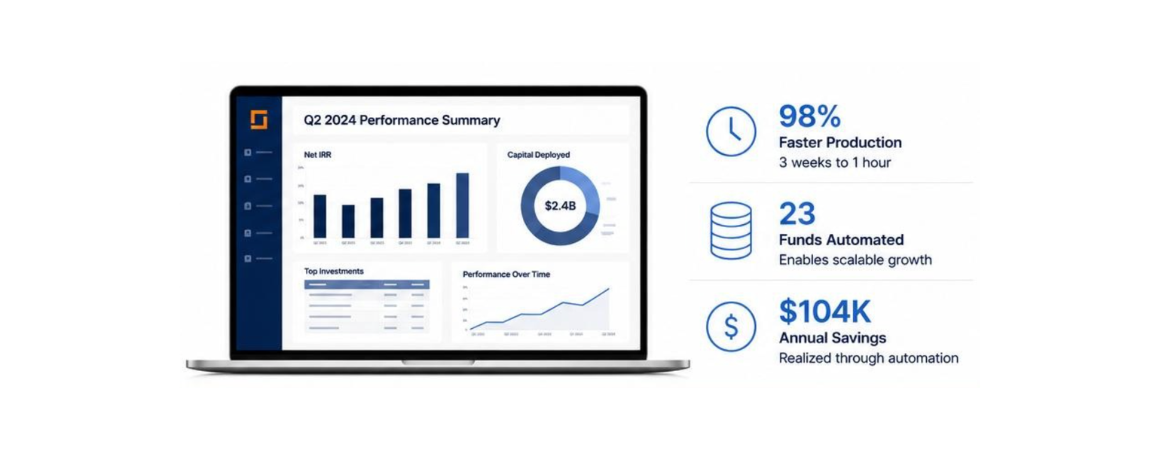
- $104,000+ in annual operational savings
- Significant reduction in manual production effort across internal teams
- 98% faster quarterly reporting cycles with improved accuracy and consistency
- Reduced dependency on specialized institutional knowledge and manual workflows
- Improved confidence across marketing, operations, and compliance teams
- Automated 23 funds using a scalable infrastructure capable of supporting new fund launches with minimal incremental effort
- Enhanced organizational alignment and trust in the reporting process
- Ability to rapidly onboard new funds into the automated workflow
- Production-ready reports generated at scale while maintaining brand and regulatory integrity
Today, the firm operates with a far more flexible and scalable content production model — enabling growth without proportionally increasing operational burden or headcount.
Key Takeaway
The challenge was not simply creating more automation, but operationalizing data, workflows, and collaboration across teams. By reducing execution friction and improving data delivery, the firm built a scalable reporting operation without increasing headcount.