What’s really holding up your factsheet production? (Hint: It’s a four-letter word)


Factsheets are a staple of the investment marketing collateral mix. Studies show that they are still the most widely used sales tool in the field. Every quarter, there is a rush to get them into the hands of the sales force faster than competitors. Many factors slow down factsheet production timelines, but the most critical factor is… data.
The efficiency, accuracy, and consistency of marketing and communication output is directly tied to a firm’s data management strategy. Firms can significantly reduce their time-to-market and risks associated with factsheet production by automating their data management process.Read More
Designing with Raster vs. Vector Images
Vector, GIF, Illustrator, TIFF, JPEG, PNG, EPS, Raster, PSD – what does it all mean?
With so many graphic formats one can use these days, how do you know which one to use for your project?
In this post, I will explain what the differences are and how you can put this knowledge to use. The two categories of image types we will discuss here are raster images and vector graphics.Read More
Key Takeaways From Our 2018 Factsheet Production Study
In 2018, we conducted a Mutual Fund Fact Sheet Production Study, where we analyzed 235 factsheets from 47 asset management firms of all shapes and sizes. A few factors observed included publish date, modification date and how the file was produced. The two most observed methods were using automation and producing factsheets manually. To find the firm’s production method, we turned to the metadata to show us what applications, software, or tools they were using to create the PDFs. After digging deeper into the metadata, we identified some key reasons why firms have longer production durations or later release dates. We were also able to make some observations about what drives efficiency, and the findings were pretty shocking. Read on to get the scoop!
Build or Buy: How to Decide?

When looking at content automation and sales enablement solutions, firms are often confronted with a tough decision: To build or buy? Over the past 20 years, I’ve participated in many of these discussions and seen it go both ways. Sometimes the decision is successful and other times it ends up a costly mistake. On one hand, it isn’t always less expensive nor less risky to build software as opposed to buying commercial solutions. For example, when application development projects are initiated with the intent of justifying and maintaining the technology team. Then, unfortunately, they never get off the ground because they can’t be supported technically or economically. What then happens, after all the internal effort and expense, is a new commercial solution is procured to replace it.
On the other hand, sometimes the technological or business needs are so pertinent to operations that they cannot be outsourced. In these circumstances, there’s a good case for insourcing as opposed to outsourcing if the board of directors approves. Also, the IT organization must be truly committed to the budget and vision. At the end of the day, the success or failure of development efforts should be measured against the same criteria. When weighing the decision to build or buy, I recommend using these six criteria:
-
 The Future of Asset Management Marketing: 8 Takeaways from Our Fireside Chat with CMO Lara Hoffmans, CFA
 -
7 Problems With Automating Factsheets In PowerPoint
-
 The Growing Importance of ADA Compliance for Investment Companies
 -
Four, No FIVE things to Look for in a Content Automation Solution
-
10 Best Practices for Tailored Shareholder Report Design
-
 The Future of Asset Management Marketing: 8 Takeaways from Our Fireside Chat with CMO Lara Hoffmans, CFA
 -
7 Problems With Automating Factsheets In PowerPoint
-
The Growing Importance of ADA Compliance for Investment Companies
-
Four, No FIVE things to Look for in a Content Automation Solution
-
10 Best Practices for Tailored Shareholder Report Design
Video: Who is Synthesis?
Premium Resources
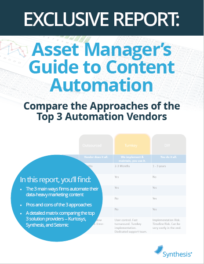 Compare the Top 3 Finserv Content Automation Vendors [White paper]
 Create Pitchbooks the Drive Sales [White paper]
 Build vs. Buy: Should Your Financial Services Firm Outsource or Insource Marketing Technology? [White paper]
  10 Tips for Rebranding your Fund Marketing Documents [White paper]
Recent Posts



Video: Who is Synthesis?