Content Automation Platforms: Why the Operating Model Decides Your Real Cost

Modernizing content operations used to be a feature conversation.
Which platform produces fund fact sheets, pitchbooks, commentaries, and shareholder reports fastest? That question still matters, but it is no longer the one that determines what automation actually costs you. The harder question sits underneath it.
Once the platform is in place, who prepares the data, who maintains the integrations, who rebuilds the template when a disclosure changes, and who gets paged when a production cycle stalls at 4 p.m. before a deadline?
Every content automation platform needs an ecosystem around it. Data has to be prepared and governed. Integrations have to be maintained. Templates and business rules change, new share classes launch, disclosures evolve. Someone owns that work.
The difference between platforms is not whether the work exists. It is who ends up doing it, and what that ownership costs your firm over three, five, and ten years.
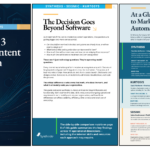
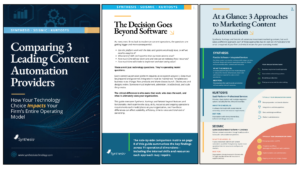
That is the lens behind our comparison of three leading approaches: Synthesis, Kurtosys, and Seismic. Four questions decide your real cost.
Get The Full Report Here
1. Data and technical readiness: will you adapt to the platform, or will it adapt to you?
Investment data almost never arrives clean. It comes from internal systems, third parties, spreadsheets, APIs, and databases, in formats that rarely agree with each other. The question is how much has to change before the platform can use it, and who does that work.
With Kurtosys and Seismic, more of that responsibility stays with you. Kurtosys offers several integration paths, including flat files, APIs, and Snowflake, but your team prepares and standardizes the data and maintains the pipeline you choose. Seismic similarly depends on customer-owned ETL and data mapping to conform data for its document workflows. In practice, that can mean standing up SQL, ETL, or data-engineering capacity you did not have before.
Synthesis works differently. It accepts data in its existing formats and provides the data and technical expertise to map, transform, and maintain those pipelines. Teams also get visibility into whether required data arrived, where it came from, and whether it is ready for production, so problems get caught before they reach a published document rather than after.
The fear worth naming here is the multi-year cleanup. If the honest answer to “how much must our data environment change” is “a lot,” you have signed up for a project, not a platform.
2. People and operational resources: what will your team still own after go-live?
Automation should reduce production effort. Software can also create new effort: building templates, configuring the platform, administering workflows, managing design changes, and troubleshooting.
The skills required vary by approach. Seismic’s workflow can span InDesign, PowerPoint, and its document layer, and Kurtosys can require InDesign proficiency for certain studio and plugin workflows. Both lean on specialized design and platform skills that someone on your team has to hold.
Synthesis does not depend on PowerPoint, InDesign, or Word to produce automated materials. It recreates your existing templates inside the platform, preserving your brand and design standards, and adjusts layouts automatically as content grows or shrinks, so designers are not manually resizing and repairing pages. More involved design changes can be handled by the Synthesis team, which keeps specialized design-software expertise off your internal payroll.
This is where key-person dependency quietly becomes a risk. When one person holds the template logic, the data quirks, and the workarounds in their head, the operation breaks the day they leave. An operating model that captures those rules inside the platform, rather than inside a person, is the one that survives turnover.
3. Speed to change and scale: how fast can you respond when the business moves?
Getting documents automated is the beginning. The real test is what happens when a new product or share class launches, a disclosure changes, a new variant is needed, or a design evolves. Each change either flows through automatically or kicks off another round of configuration and manual work.
Seismic’s one-to-one mapping can require manual rework as requirements change. Kurtosys can flow some linked content across outputs, though template-level changes may still pull in technical, design, or professional-services time. Synthesis uses centralized, rule-based automation, often described as one-click automation, so a change can be made once and propagate across mapped documents, presentations, languages, layouts, and digital channels. Compliance and disclosure rules propagate at the business rule level, which means a single update reaches every impacted output instead of every impacted template.
True scalability is not producing more content. It is absorbing change without adding people at the same rate.
4. Time and cost: what will this really cost, and how long until it pays off?
Every requirement above converges on two executive questions. How quickly will we see value, and what will it genuinely cost to get there?
The answer runs well past the license fee. Depending on the operating model, total investment can include professional services, implementation resources, data and technical talent, design expertise, platform administration, maintenance, and the opportunity cost of skilled people supporting the technology instead of doing higher-value work. Firms report implementations with Seismic and Kurtosys stretching upwards of three years. Because Synthesis works with a firm’s existing data infrastructure, implementation can finish in as little as 90 days.
That is why total cost of ownership and time to value are inseparable from the operating model itself. Comparing subscription fees alone tells you almost nothing about either.
How to read the comparison
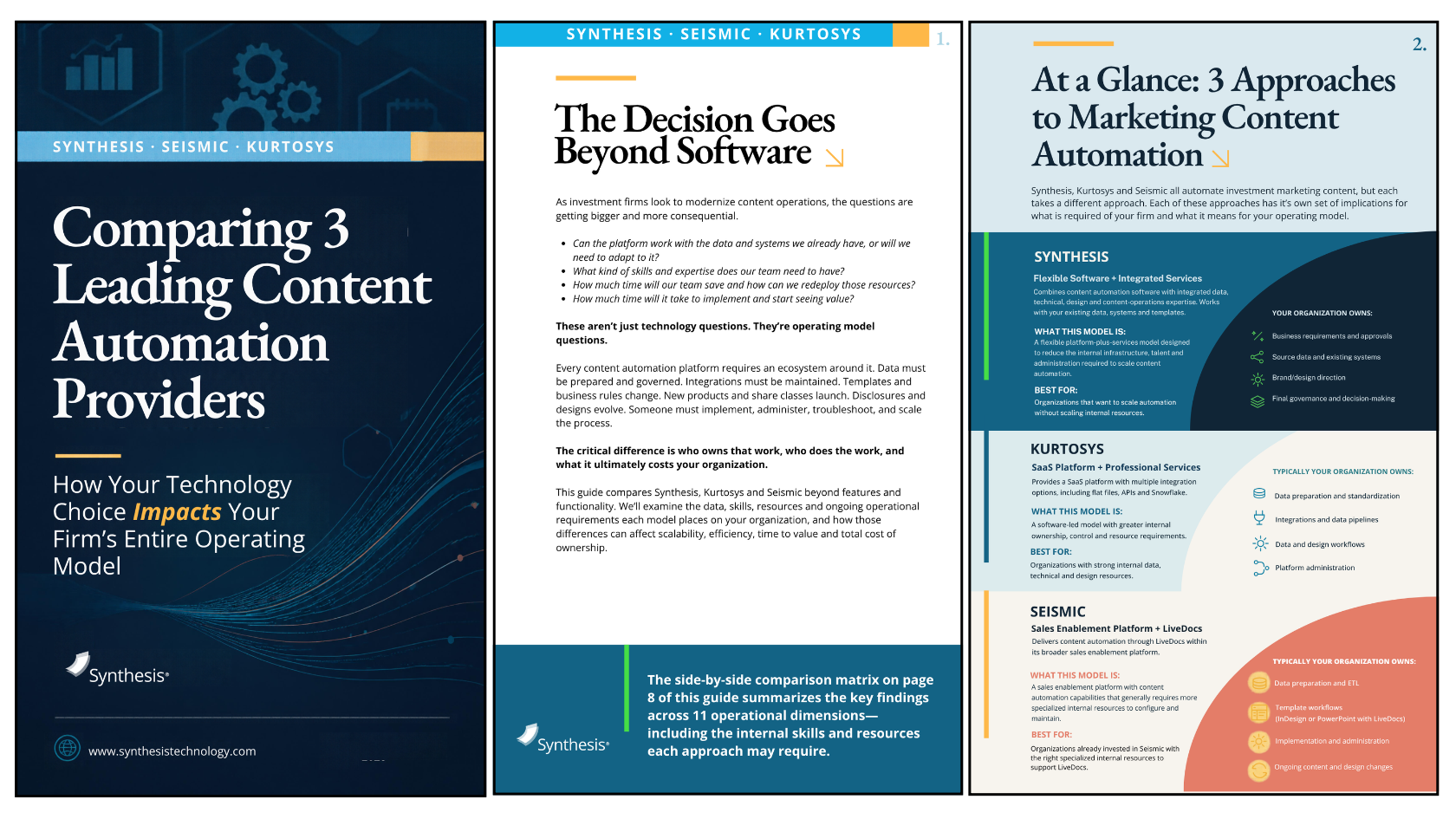
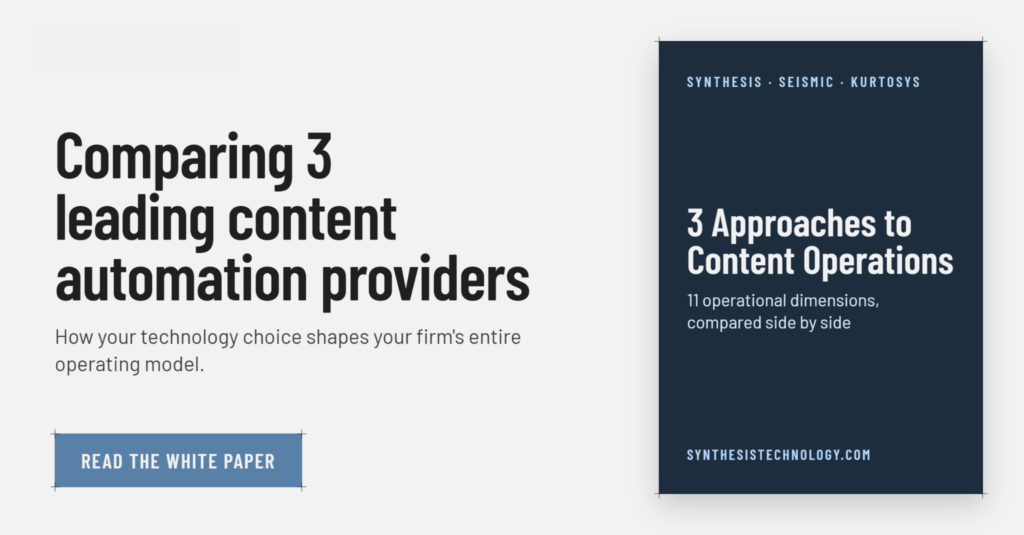
The operating-model question is simple to ask and revealing to answer: how much of the infrastructure around your automation platform do you want to build, staff, and maintain internally? Kurtosys, Seismic, and Synthesis can all automate investment content. They place very different demands on the firms that run them. The side-by-side matrix in our full guide lays out eleven operational dimensions, from data preparation to ongoing maintenance, so you can see where each approach puts the work.
The bottom line
The build-versus-buy instinct is stronger than it has been in years, and it is easy to see why. AI tools make the first draft of automation feel reachable in-house, and a lean marketing budget makes “we can do this ourselves” sound responsible. The break-even math is where that instinct gets tested. A tool that is cheap to license is not cheap to run if your own people spend their weeks preparing data, maintaining templates, and chasing production issues, and the exposure compounds the moment a regulator asks how a disclosure was generated and version-controlled.
The goal of automation was never to trade one manual process for a new set of technical and administrative ones. It was to build an operating model that lets the firm produce more, move faster, and scale without its people, cost, and complexity scaling in lockstep. The right platform is not the one with the longest feature list. It is the one that fits the operating model you actually want to run, and that keeps the institutional knowledge of how your content works inside the system rather than inside the few people who happen to remember it today. That is the comparison worth making before you choose.
Frequently asked questions
What is the difference between Synthesis, Kurtosys, and Seismic?
All three automate investment marketing and reporting content, but they divide the work differently. Kurtosys is a SaaS platform paired with professional services, Seismic delivers content automation inside a broader sales enablement platform, and Synthesis combines content automation software with integrated data, design, and content-operations services, so the firm owns less of the surrounding work.
What drives the total cost of ownership of a content automation platform?
Far more than the license fee. Data preparation, integrations, specialized technical and design talent, implementation, administration, maintenance, and the opportunity cost of internal teams supporting the platform all contribute. The operating model determines how much of that cost lands on your firm.
How long does implementation take?
It depends on how much your data environment has to change. Firms report implementations with some platforms taking upwards of three years. Because Synthesis works with existing data infrastructure, implementation can finish in as little as 90 days.


-
 Content Automation Platforms: Why the Operating Model Decides Your Real Cost
-
 The Future of Asset Management Marketing: 8 Takeaways from Our Fireside Chat with CMO Lara Hoffmans, CFA
-
7 Problems With Automating Factsheets In PowerPoint
-
The Growing Importance of ADA Compliance for Investment Companies
-
 Four, No FIVE things to Look for in a Content Automation Solution
-
 Content Automation Platforms: Why the Operating Model Decides Your Real Cost
-
The Future of Asset Management Marketing: 8 Takeaways from Our Fireside Chat with CMO Lara Hoffmans, CFA
-
7 Problems With Automating Factsheets In PowerPoint
-
The Growing Importance of ADA Compliance for Investment Companies
-
Four, No FIVE things to Look for in a Content Automation Solution
Video: Who is Synthesis?
Premium Resources
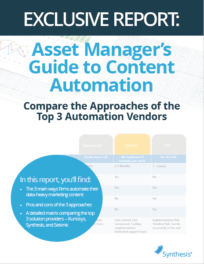 Compare the Top 3 Finserv Content Automation Vendors [White paper]
 Create Pitchbooks the Drive Sales [White paper]
 Build vs. Buy: Should Your Financial Services Firm Outsource or Insource Marketing Technology? [White paper]
 10 Tips for Rebranding your Fund Marketing Documents [White paper]
Recent Posts



Video: Who is Synthesis?